
When Distress is Drugged Instead of Held

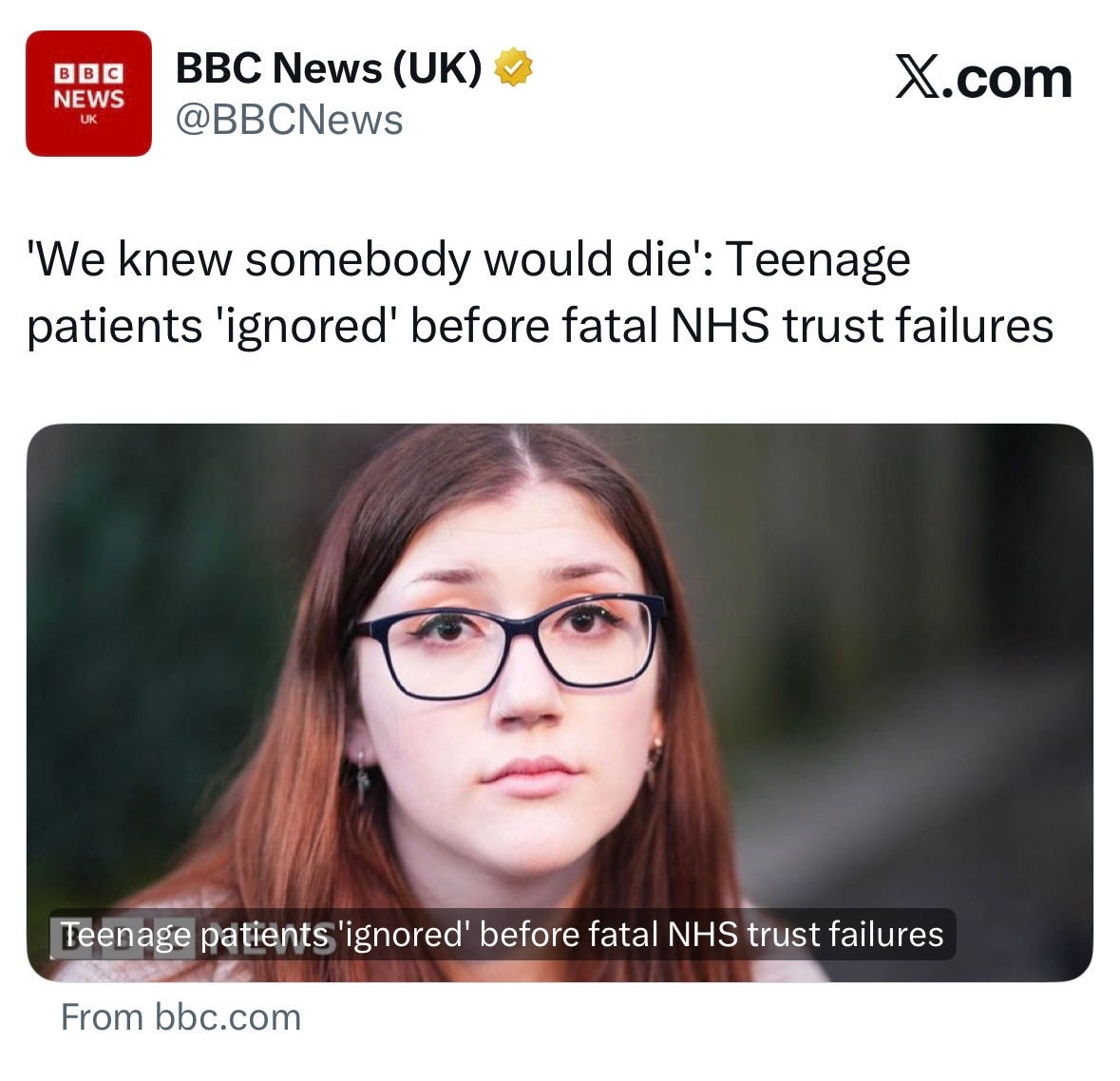
Another trust.
Another hospital.
Another set of young lives.
Another set of families left saying the same unbearable sentence:
“We warned them.”
This is not one rogue ward.
This is not one bad apple.
This is a culture.
Children and teenagers arrive in unbearable distress and what do they meet?
Not deep listening.
Not warmth.
Not nervous-system safety.
Not real healing.
Not space to scream, cry, shake, rage, collapse, be witnessed.
They meet protocols.
Risk assessments.
Locked doors.
Restraint.
Observation charts.
And medication.
I know this because I experienced it myself in a private hospital.
There was no real care.
No sacred holding.
No meaningful healing therapies.
No “what happened to you?”
No “what is your body trying to release?”
No “how can I help you feel safe enough to express this?”
I had a meltdown and was immediately offered Valium.
That was the answer.
Not presence.
Not compassion.
Not emotional containment.
Drugs.
Handed out like sweets in places that call themselves therapeutic.
And then when people deteriorate, self-harm, become suicidal, shut down, dissociate, or lose the will to live, the system behaves as though this came from nowhere.
It did not come from nowhere.
It came from a model that too often suppresses distress instead of understanding it.
I made an official complaint about this hospital funded through Surrey and Borders pathways, because patients are still being sent into these same kinds of “treatment” environments.
And now here we are again.
Another trust.
Another headline.
Another death.
Another family forced to fight for truth after the harm has already happened.
At what point do we stop calling this care?
At what point do we admit that a system built around containment, compliance and chemical management is not healing our children?
They do not need more sedation.
They need safety.
They need compassion.
They need skilled adults who can hold distress without fearing it.
They need real therapy, real nutrition, real body-based support, real trauma-informed care and real humanity.
Because a child in agony is not a behaviour problem.
A teenager in crisis is not a diagnosis to be managed.
They are a human being asking, in the only language they have left,
“Can anyone actually hear me?”
It's a bloody disgrace